
Amur honeysuckle (Lonicera mackii)was brought to the United States in the mid-1890s as an ornamental shrub. Decades later it would be revered as an important species for improving bird habitat, even by professional land managers. Now it is reviled and seen as a scourge and formidable foe upon the landscape. Most commonly known as bush honeysuckle, this species is a member of the Caprifoliaceae family. Amur honeysuckle is one of most widely distributed invaders in Illinois and poses significant risks to our native species and ecosystems.
Identification:
- Up to 15-20 feet.
- 2-3.5 inches long of opposite arrangement. Ovate with simple margins and a tapered, pointed tip (acuminate). Hairs along veins.
- The center of mature stems (pith) is hollow. This is a key identifying factor.
- Striated (striped) and tan in color.
- Tubular with 5 petals (4 fused), white to yellow, in pairs. Approximately 1 inch long from the leaf axil.
- Shiny red berries, about the size of a pea. Often persists through the winter.
- Look-alikes: Young Amur honeysuckle can resemble the native coralberry (Symphoricarpos orbiculatus). Coralberry has oval-ovate leaves that do not have the pointed tip like Amur honeysuckle, nor does it have a hollow pith. The fruit of the coralberry is a pinkish purple. This native shrub only grows to a height of 4 feet.
Note the opposite arrangement and smooth margin of the leaves. (Photo by Nick Seaton)
Amur honeysuckle beginning to bloom in spring. (Photo by Nick Seaton)
Invasive Advantages: Several mechanisms make this species a fierce competitor on the southern Illinois landscape. The first of these advantages is that Amur honeysuckle can establish itself in undisturbed habitats. Many other invasive species need disturbed mineral soil and/or increased sunlight via clearing or canopy gaps to give them a foot in the door, this is not the case with bush honeysuckles. This characteristic puts almost all ecosystems in Illinois at risk.
The final trait that makes this species so problematic relates to seed dispersal. Before the negative consequences of Amur honeysuckle were realized, it was touted for bird habitat and forage. While it certainly has provided many meals to birds over the decades, our avian benefactors have unwittingly become the primary vessel for disseminating the seeds of this menace. When you consider the great distances birds travel, how often they relieve themselves, and the fact that Amur honeysuckle can invade undisturbed habitats, the spread and establishment of this species more likely than not.
Brightly colored, persistent, and abundant, the fruit of Amur honeysuckle are often eaten by birds. (Photo by Nathan Speagle)
Habitat and Ecological Impacts: Amur honeysuckle can invade and establish in a wide variety of habitats as this species can grow in full sun or full shade. It is commonly found on forest edges, along roadsides, in old pastures and fields, but also thrives in forest interiors. Upland forests are readily invaded, and bottomland forests are prone if soil saturation is periodic. In urban settings, it is often found in fence rows and on property lines as some homeowners unfortunately value the privacy this species provides.
Due largely in part to the invasive advantages previously discussed, Amur honeysuckle can from dense thickets and establish dominance in forest understories. As this species invades, it drives out native grasses, forbs, shrubs and trees, degrading habitat for native fauna. Mature infestations can inhibit tree regeneration, altering species composition, stand structure and productivity. In some cases, infestation has been shown to reduce growth of mature canopy trees by up to 50%.
Control: Amur honeysuckle is most effectively controlled using a combination of treatment methods. The different treatments are most effective at different times of the year, so timing is important.
- involve hand pulling or using a specialized tool to remove the entire shrub, roots and all, from the ground. While mechanical treatments have the advantage of not using herbicide, they do cause soil disturbance that can open the door for re-invasion from honeysuckle or other invasive species. Amur honeysuckle has a shallow root system and utilizing this method when soils are soft allows for removal with reasonable effort. After soaking rain events and early spring following the freeze and thaw cycles of winter are ideal. However, this treatment has somewhat limited applications. Hand pulling is simple for seedlings and smaller establishing plants but becomes increasingly difficult once plants become more than 2 feet tall. For shrubs of moderate size, specialized pulling tools like the Weed Wrench and Puller Bear provide increased mechanical advantage for unearthing root wads.
- like prescribed fire will not provide effective control on their own. While it is possible to top kill Amur honeysuckle with fire, the root system will not be affected. Other methods must be used in conjunction if fire is applied to the landscape.
- of Amur honeysuckle include foliar, cut-stump, and basal-bark applications of herbicide. Foliar treatments are performed during the summer months and are best for small to medium sized shrubs (shoulder height and below). Cut-stump and basal-bark treatments are most effective mid-summer to late winter and are best for medium to large shrubs.
Foliar treatments use a low concentration of herbicide that is applied to all of the leaves on the shrub. The tools generally used for this method are multi-gallon handheld or backpack sprayers, or pump driven systems mounted on an ATV, UTV, or truck. In a local study, glyphosate was shown to be the most effective herbicide for this treatment, far surpassing the results achieved with triclopyr. When performing foliar applications, be sure to treat all of the foliage for maximum efficacy. Avoid spraying over shoulder height to ensure foliage is not missed and to minimize the chances of the applicator being exposed to spray drift.
Cut-stump treatments involve cutting all of the stems of a shrub near the ground and applying a concentrated herbicide to the stump with a sprayer or brush. Depending on size, cuts can be made with loppers, handsaws, brush cutters and chainsaws. For individuals not comfortable with chainsaws and other power equipment, battery-powered reciprocating saws (Sawzall) with an arborist blade are a great option. Every stem of the shrub must be cut and treated with herbicide, with herbicide application immediately following cuts. There is no size limitation on this treatment, though size may dictate how the herbicide is applied. For stems smaller than 5 inches, treat the entire cut face of the stump. For stems larger than 5 inches, only treat the outer 2 inches of the cut face with herbicide. While more labor intensive than basal-bark treatments, it uses considerably less herbicide. Glyphosate in a 20-50% solution or triclopyr in a 20-25% solution are both viable options for this treatment. The concentration used varies among the different formulations of these herbicides, and some may require an oil-based carrier, please consult the herbicide label and/or a local forestry professional before mixing and applying herbicide.
Basal-bark treatments involve treating the entire circumference of lowest 15 inches of each stem with a concentrated herbicide solution in an oil-based carrier. For small infestations and smaller stems, a hand-held spray bottle may be used. For extensive infestations where the applicator may be working for several hours, a backpack sprayer may be a better option. Similar to the cut-stump method, every stem must be treated to be fully effective. However, one of the drawbacks to basal bark is that is has size limitations. Generally, stems larger than 4-5 inches have bark that is too thick for the oil-based solution to penetrate, meaning cut-stump is your best option. A 20-25% solution of triclopyr ester (Garlon 4, Tahoe 4, Element 4, etc.) in an oil-based carrier (basal oil, diesel fuel, No. 1/No.2 fuel oil) is generally the most effective herbicide for these treatments. However, concentrations vary among the different formulations of this herbicide, please consult the herbicide label and/or a local forestry professional before mixing and applying herbicide.
**SPECIAL NOTE ON TRICLOPYR ESTER** – Do not apply in temperatures exceeding 85 degrees as ester formulations may volatize and damage non-target plants.
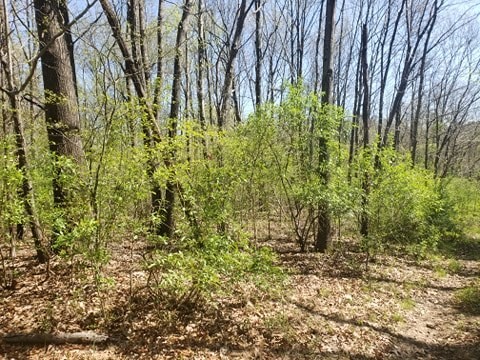
Amur honeysuckle in early spring before native woody species have broken bud. (Photo by Nick Seaton)