
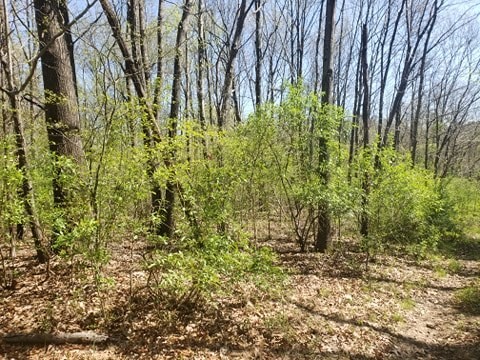
Japanese honeysuckle (Lonicera japonica) was introduced to the United States at the turn of the 19th century as an ornamental. Native to eastern Asia, it has been used for ground cover, erosion control and wildlife forage. Many people value it for its showy and fragrant flowers, in addition to providing privacy. This species is not a state-listed noxious weed in Illinois, but its sale is prohibited under the Illinois Exotic Weed Act.
Life Cycle: Japanese Honeysuckle is a semi-evergreen, woody, trailing or climbing vine. It is considered semi-evergreen because it will often retain its leaves until late winter, with bud break and new foliage following shortly after. This species greens up very early, with new foliage coming as early as February. Flowering begins in late spring to early summer and generally continues through mid-summer. Flowers are replaced by fruits that become mature in the fall. Fruits are black and pea-sized with 2-3 seeds inside. This species reproduces by seed and vegetatively through rhizomes.
Identification:
Leaves: Opposite arrangement, 2-3 inches in length, with smooth margins. Will stay green after frost. Young, establishing plants may have lobed leaves that resemble small oak leaves.
Stems: Young stems are green and hairy (pubescent), moving to a purplish brown with maturity.
Bark: Mature vines have light brown bark that peels in strips.
Flowers: Tubular, white or yellow, up to 1.5 inches long. Usually in pairs.
Fruit: Black, about 0.25 inches in diameter. Contains 2-3 seeds.