
Chaff Flower Achyranthes japonica (miq.) Nakai, (Amaranthaceae) commonly known as Japanese Chaff Floweris of growing concern throughout its introduced range in North America. Native to eastern Asia, it was first discovered in 1981 in Martin County, KY along the banks of the Tug Fork River within the Big Sandy watershed (Medley,1985) . Since its discovery it has expanded its range throughout the Ohio River flood plain (Evans & Taylor, 2011; Vincent & Cusick, 1998) and more recently within the Mississippi River flood plain and into southern Illinois. New “spontaneous” populations have begun to appear due to the species adaptability and ease of spread.
Life Cycle: Achyranthes japonica is a perennial plant which means that it will re-appear each year. Each plant grows a stem with a flowering spike composed of many white non-showy flowers. Each flower is pollinated and matures into a fruit with a small appendage capable of clinging and travel. Many seeds fall to the ground producing hundreds of individuals around the parent plant. In the spring, leaves will emerge along with new plants germinating from the overwintered seeds that fell. Large flushes of germinated plants are common where seed deposition was heavy. Seed viability is high across its introduced range, but flooding can negatively impact germination
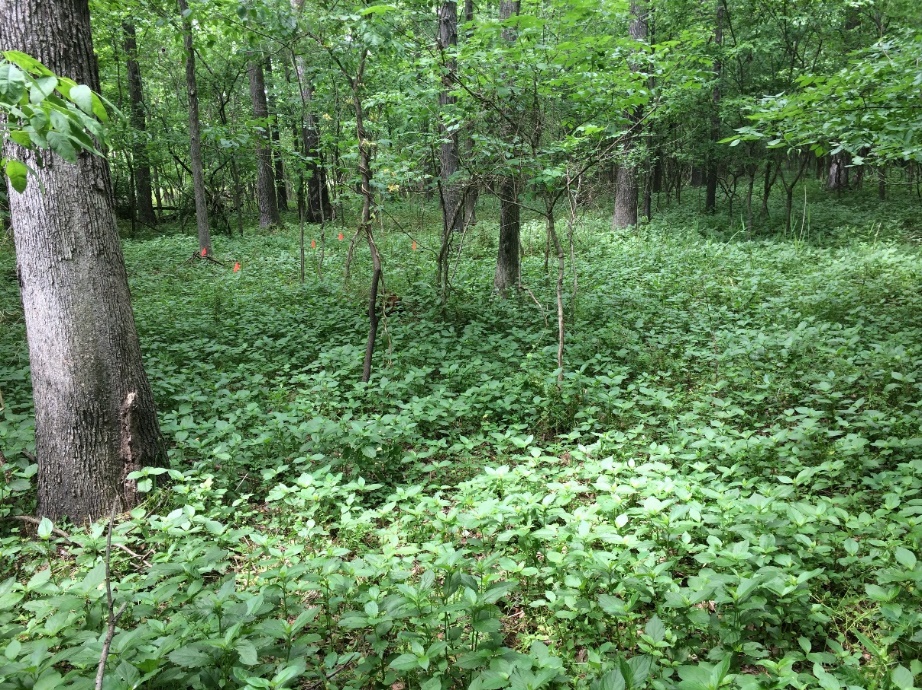
An infestation of Achyranthes japonica in the understory of a southern Illinois forest. Infestations can quickly grow to these levels if they go unnoticed or unmanaged
Identification: Plants can be identified by their opposite leaves, pointed or tapering (acuminate) tips and red coloration on the nodes. Later in the season they can be easily spotted by their flowering spikes. New plants will begin to emerge in spring and grow throughout the summer
- Height: 1.5 – 3 meters tall
- Leaves: Ovate, elliptic simple leaves with acuminate tips and tapering base. Margins are smooth and leaves are slightly waxy or appear to be shiny
- Flowers: non showy small white flowers in an elongated spike
- Fruit: each flower produces a seed with a small subulate spinose bracteole
- Seeds: elliptic and encased
- Roots: young plants have small rooting systems, but older plants have large extensive rooting systems that can produce many flowering stems
- Scent: there is no noticeable scent
- Look-alikes: Lopseed (Phyrma leptostachya), Pigweeds (Amaranthus genus), Indian pink (Spigelia marilandica), white vervain (Verbena urticifolia)
Achyranthes japonica growth form and habit
Ovate, elliptic simple leaves with acuminate tips and tapering base.
Margins are smooth and leaves are sometimes slightly waxy or appear to be shiny
red coloration on the stem and near the nodes
non-showy flowering spike being pollinated
mature seeds appearance during the dormant season
*spread is most likely at this time of the plant’s life cycle*
Invasive Advantages: Modes of seed dispersal include local fauna that pass through infestations and carry seeds to new satellite locations as well as pets, humans and water (Evans & Taylor, 2011; Medley et al., 1985; Vincent & Cusick, 1998). A study in Korea found that bird feathers had carried seeds from one location to another suggesting epizoochory as an important dispersal mechanism (Choi, Nam, & Chae, 2010).
Habitat and Ecological Impacts: After establishment, infestations quickly decrease local diversity through competition and can make travel difficult for wildlife passing through the thatch. Populations have been found in numerous habitats and the species adaptability and ease of spread has helped to expand its range quickly across the region.
Overwintered thatch from the previous year’s growth
Control:
- Mechanical treatments: Small plants can be hand pulled, but established plants will likely need follow-up with a systemic herbicide as it is difficult to ensure complete removal of all root material.
- Cultural treatments: Within its native range, macaques have been reported to consume A. japonica leaves as a food source (Huffman & Andrew, 2012). A pathogenic fungus Cercospora achyranthis can also cause decreased growth within the Achyranthes genus (Groenewald, Groenewald, & Crous, 2005; J. Z. Groenewald et al., 2013). A species of Lepidoptera, Lasioptera achyranthii, produces galls on A. japonica plants and feeds on leaves after emergence (Yamazaki & Sugiura, 2003). A study in southern Illinois looking at the effects of single-entry fire found that plants were negatively impacted but that populations were capable of quick recovery from seed. Another study in southern Illinois noted white tailed deer browsing preference but did not find an impact on seed production.
- Chemical treatments Management of this plant can be accomplished with a foliar herbicide application using Triclopyr or Glyphosate at a 2% rate. Herbicide applications can be made from May through September. Cover all parts of the leaves with herbicide. In areas that are severely infested, multiple visits may be necessary. Always follow the instructions provided on the label of the herbicide being used. Check clothing for seeds after visiting infested areas.
*After seeds begin to fall avoid infested areas to prevent further spread*