
Autumn olive (Elaeagnus umbellata) was introduced to the United States in the 1830s as an ornamental shrub. Native to China, Japan and Korea, this species has also been used for soil stabilization, mining reclamation, and highway barriers. Much like Amur honeysuckle, it was also touted as a valuable species for bird habitat and forage only decades ago. Now this species is the most common woody invader of edge and open lands habitat throughout southern Illinois.
Life Cycle: Autumn olive is an upright, often multi-stemmed, deciduous shrub. In southern Illinois, it generally starts to break bud and leaf out in February and/or March, making it one of the earliest woody species to begin the green up process. Flowering follows shortly after in April. Seeds are produced over the summer months and are mature by mid-summer/early fall. Even though it is one of the first to leaf out, it is usually one of the last to drop its foliage in the fall.
Identification:
- Height: Up to 20 feet.
- Leaves: 1-3 inches long of alternate arrangement. Ovate or elliptic-oblong with simple margins. Underside of the leaf looks like it has been speckled with silver spray paint, this is a key identifying feature.
- Stems: Alternate arrangement. Younger stems are brown to gray brown that look like they have been speckled with bronze spray paint.
- Bark: Mature stems are gray with large lenticels, may be furrowed.
- Flowers: Small, yellowish white, that appear after leaf out in the spring.
- Fruit: Silvery pink to bright red drupes, about the size of a pea.
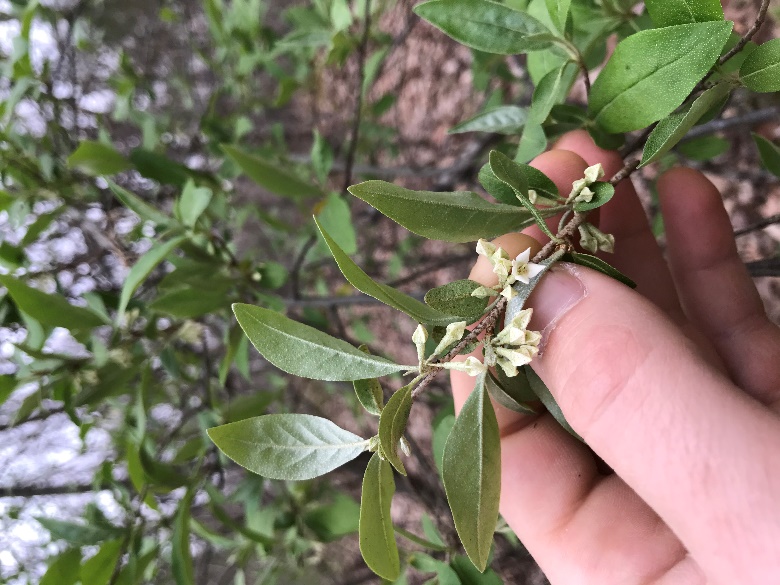
Silvery underside of the leaf and flowers. (Photo by Nick Seaton)
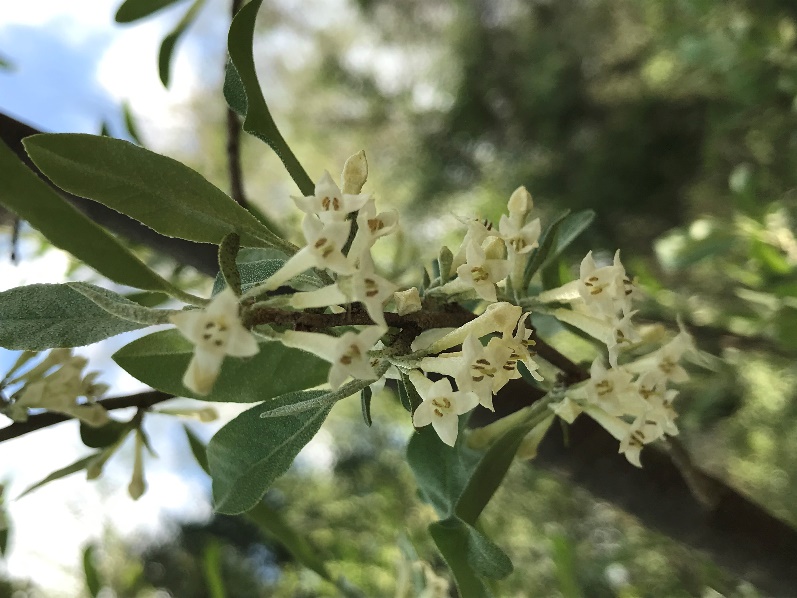
Flowers during the spring bloom.
Invasive Advantages: Autumn olive has a few characteristics that give it a leg up on the region’s native species. The most adventitious of these qualities are related to phenology and reproduction.
As mentioned in the life cycle section, autumn olive is one of the first woody plants to leaf out in the spring and among the last to drop them in the fall. This means this species has an extra 4-6 weeks of growing season per year compared to our native trees and shrubs. As if that weren’t enough of an advantage, that extra growing time is relatively free of competition.
When it comes to reproduction, autumn olive posses two traits that make it especially problematic. The first is that this species can reproduce through seed and vegetatively via root suckers. As the name suggests, root suckers come from the root system of established shrubs. It is because of this ability that mowing and burning without some kind of chemical control are not recommended.
The other reproductive trait that gives autumn olive an advantage is related to seed dispersal. Due to the abundance and showiness of the fruit, autumn olive berries are often eaten by birds and mammals of all sizes. This allows seeds to be transported far from the infestations in which they were produced and invade areas where this invasive shrub is not currently present.
Habitat and Ecological Impacts: While autumn olive can invade and establish in many different habitats, it generally does not do well in heavily shade. The specie’s preference for full to partial sun is a big reason whey it often dominates forest edges, old pastures and fallow fields. It also thrives in prairies, savannahs, and woodlands. It does well in many soil types and tolerates high pH. Though it prefers dry to moist soils, it can be found in bottomland and riparian areas that are well drained.
Once established, autumn olive can quickly dominate an ecosystem and outcompete native species. Having an extended growing season and almost full leaf out by the time native species are starting to break bud gives this species a great advantage. Its dual reproductive method and seed dispersal strategy also grant this aggressive invader strength in numbers. Native grasses, forbs, shrubs and trees all struggle to find sun and compete for resources under autumn olive. Thus, reducing species richness and abundance, and degrading habitat for native wildlife.
Autumn olive can also impact water quality. This species is a nitrogen fixer, so it can be highly problematic in riparian areas. Dense infestations on stream and river banks can leach excess nitrate into waterways and degrade water quality.
Control: Due to the characteristics of this plant, mechanical and cultural treatments are of very limited effectiveness, meaning chemical treatments are the primary avenue to containment and eradication.
- Mechanical treatments involve hand pulling seedlings. The root system of autumn olive is not as shallow as Amur honeysuckle, making pulling this species significantly more difficult past the seedling stage. It is not advised to pull anything larger than seedlings as part of the root system will likely remain in the soil, which can re-sprout or root sucker.
- Cultural treatments like prescribed fire will not provide effective control on their own. While it is possible to top kill autumn olive with fire, the root system will not be harmed, and a root suckering response may be triggered. Heavy infested areas generally burn very poorly as autumn olive litter does not carry fire well. Chemical methods must be used in conjunction if fire is applied to the landscape.
- Chemical treatments of autumn olivce include foliar, cut-stump, and basal-bark applications of herbicide. Foliar treatments are performed during the summer months and are best for small to medium sized shrubs (shoulder height and below). Cut-stump and basal-bark treatments are most effective mid-summer to late winter and are best for medium to large shrubs.
Foliar treatments use a low concentration of herbicide that is applied to all of the leaves on the shrub. The tools generally used for this method are multi-gallon handheld or backpack sprayers, or pump driven systems mounted on an ATV, UTV, or truck. In a local study, triclopyr amine was shown to be the most effective herbicide for this treatment, far surpassing the results achieved with glyphosate. When performing foliar applications, be sure to treat all of the foliage for maximum efficacy. Avoid spraying over shoulder height to ensure foliage is not missed and to minimize the chances of the applicator being exposed to spray drift.
Cut-stump treatments involve cutting all of the stems of a shrub near the ground and applying a concentrated herbicide to the stump with a sprayer or brush. Depending on size, cuts can be made with loppers, handsaws, brush cutters and chainsaws. For individuals not comfortable with chainsaws and other power equipment, battery-powered reciprocating saws (Sawzall) with an arborist blade are a great option. Every stem of the shrub must be cut and treated with herbicide, with herbicide application immediately following cuts. There is no size limitation on this treatment, though size may dictate how the herbicide is applied. For stems smaller than 5 inches, treat the entire cut face of the stump. For stems larger than 5 inches, only treat the outer 2 inches of the cut face with herbicide. While more labor intensive than basal-bark treatments, it uses considerably less herbicide. Glyphosate in a 20-50% solution or triclopyr in a 20-25% solution are both viable options for this treatment. The concentration used varies among the different formulations of these herbicides, and some may require an oil-based carrier, please consult the herbicide label and/or a local forestry professional before mixing and applying herbicide.
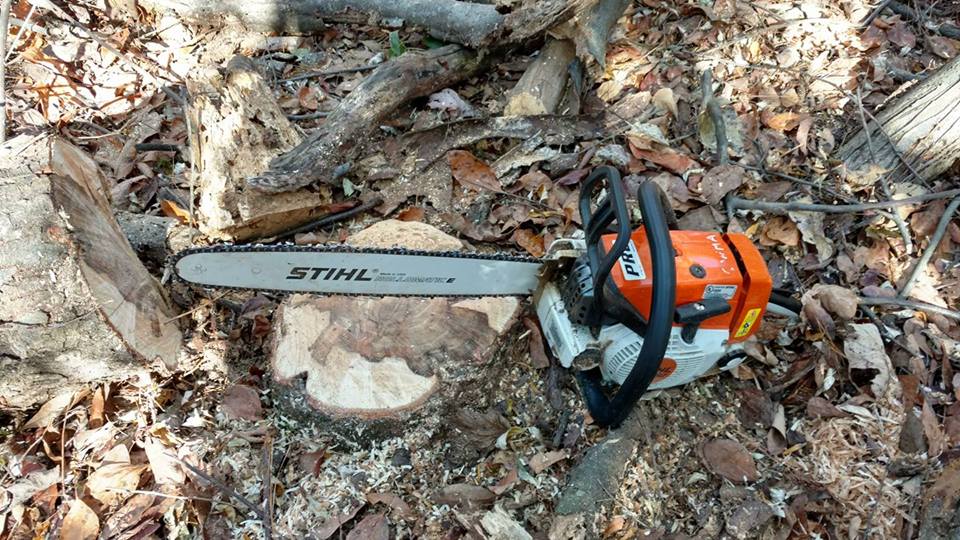
Cut-stump treatment performed on large autumn olive, herbicide was applied after photo.
Basal-bark treatments involve treating the entire circumference of lowest 15 inches of each stem with a concentrated herbicide solution in an oil-based carrier. For small infestations and smaller stems, a hand-held spray bottle may be used. For extensive infestations where the applicator may be working for several hours, a backpack sprayer may be a better option. Similar to the cut-stump method, every stem must be treated to be fully effective. However, one of the drawbacks to basal bark is that is has size limitations. Generally, stems larger than 4-5 inches have bark that is too thick for the oil-based solution to penetrate, meaning cut-stump is your best option. A 20-25% solution of triclopyr ester (Garlon 4, Tahoe 4, Element 4, etc.) in an oil-based carrier (basal oil, diesel fuel, No. 1/No.2 fuel oil) is generally the most effective herbicide for these treatments. However, concentrations vary among the different formulations of this herbicide, please consult the herbicide label and/or a local forestry professional before mixing and applying herbicide.
**SPECIAL NOTE ON TRICLOPYR ESTER** – Do not apply in temperatures exceeding 85 degrees as ester formulations may volatize and damage non-target plants.